This blog was formally titled Faith, Facts and Fiction. The focus is on dealing with the Christian Faith in both Facts (Biblical Teaching, Apologetics) and Fiction (or in other words, the arts including music, novels, and visual arts.) Posts will include interviews and reviews.
Saturday, July 19, 2025
BOOK REVIEW - "A CLEAR AND PRESENT WORD: THE CLARITY OF SCRIPTURE" BY MARK D. THOMPSON
Sunday, November 3, 2024
REVIEW - "HERE WE STAND: 31 REFORMERS, 1 PER DAY" BY DESIRING GOD
Okay, how do I classify this? Is it a book? If so, it would be a good one, But there is no indication of it being published. Desiring God, connected to John Piper, released this on-line. When I saw it promoted in September, I signed up to receive it each day throughout October in honor of Reformation Day. I'm glad I did - it was a blessing.
- John Wycliffe
- William Tyndale
- Jan Huss
- Simon Menno
- Peter Waldo
- Mr. and Mrs. Martin Luther (the latter was the first person Warren Wiersbe introduced in "50 People Every Christian Should Know")
- Philip Melanchthon (my hero and personal favorite)
- Ulrich Zwingli
- John Knox
- John Calvin
- Theodore Beza
- Jacob Arminius
Thursday, November 9, 2023
THE MOST WONDERFUL TIME OF THE YEAR AND OTHER POST REFORMATION DAY THOUGHTS
![]() |
| The River Community Church, Cookeville, TN |
Hope you've enjoyed my Reformation Day series, where I reviewed five books and an album. Let me close with some thoughts.
Two of the five books I reviewed focused on the Reformation. Both books had several references to Augustine, Luther, and Calvin. But other reformers didn't get as much love. In one book, Melanchthon was mentioned four times and Zwingli twice; the other didn't list either. But that book did mention Wycliffe and Tyndale more. And is John Knox a Reformer? Neither book mentioned him.
I looked up "Sola Scriptura" on Spotify, and found several selections listed. At first, I was excited - several albums on the subject I could review and lengthen this series! Alas, most of the selections were either rap (not my cup of tea), singles, in a foreign language, or in one case didn't reflect the subject of the title. ðŸ˜
I will mention that Reformation Day starts what I consider "The Most Wonderful Time of the Year." No, Christmas isn't part of the time; in fact, my favorite holiday - Thanksgiving - isn't in that period. I could call it "Holy Week," though that name is taken. This time is a week (or less), and includes four days that are special to me. Two are set on the calendar, same date every year; the other two are always on the same day of the week. What are the four?
- Reformation Day, October 31st. No duh. After all, I did say it started with Reformation Day, didn't I? I want to keep a Semper Reformanda mindset, always reforming.
- All Saints Day, November 1st. No, I'm not a Catholic, and I don't define a saint as they do - I believe all Christians are saints, and I believe the New Testament backs that up. But I want a time to celebrate those who have been inspirations to me, whether they're currently in heaven or on earth.
- International Day of Prayer For The Persecuted Church, 1st Sunday of November. (I'm actually writing this on that day.)
- World Day of Prayer for Child Evangelism Fellowship, 1st Wednesday of November.
So, let me end by trying to start a discussion. What do these four days I just mentioned mean to you? If you aren't thinking of those days, how can you make them more meaningful?
Tuesday, November 7, 2023
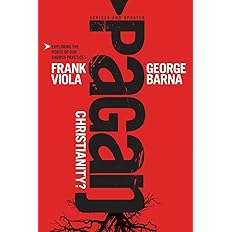
DOUBLE BOOK REVIEW - ONCE YOU SEE BY JEFF CHRISTOPHERSON AND PAGAN CHRISTIANITY BY FRANK VIOLA AND GEORGE BARNA
Yes, Reformation Day was a week ago. But is it a day we should celebrate year round? After all, many (including me) believe in Semper Reformada - always reforming.
I am reviewing not one but two books today, both of which have the Semper Reformada mindset. Both propose ideas for the church that cause us to examine where we're at and propose where we should be instead.
Allow me to start with Pagan Christianity?: Exploring the Roots of our Church Practices by Frank Viola (the baseball player?) and George Barna (the researcher), since it was published first (2012). The focal point of this book is that a lot of our church traditions are from pagan influences rather than the New Testament. The proposed reformation is to replace the institutional church with its senior pastor, sermons, and church buildings, with organic house churches. Here's the review I posted on Amazon:
"There are books that I think are on target, those that are dangerous, those that are neither (more educational or more entertaining), and those that are both. This fits in the last category.
"I've already come to some of the conclusions they came to. While I admire the big beautiful cathedrals, I wonder what would happen if the focus was on building the church through evangelism and missions instead of building bigger buildings. I also believe that there should be less distinction between clergy and laity.
"However, there are several things I disagree with. These include:
- A view that the NT prescribes a certain pattern of worship. Sorry, it's not in the NT.
- A view that appealing to the Old Testament is no better than a pagan view.
- An activist tone that isn't interested in any less than unconditional surrender.
"I did find myself scanning much of this book and reading the conclusions and the Q&A at the end of each chapter.
"They are right that most if not all features of the current institutional church are not from the Bible. The question is if it's from paganism (a bad influence) or if it's godly people desiring to serve Him."
The second book is Once You See: Seven Temptations of the Western Church by Jeff Christopherson, which came out in December, 2022. Like Pagan Christianity, this book looks at shortcomings of today's church and ways to reform - e.g. the pastors being bi-vocational. However, unlike the other book, this book is a novel. Here's my review of that book:
"Once You See: Seven Temptations of the Western Church by Jeff Christopherson is a novel looking at three men who are in a crisis in their lives and in the church, and realize there is something more that's not being realized. But how does one reach that goal?
"This book would appeal to a Christian audience. Most Christian novels are stories first, and Christian thought is organic to the tale. My hunch is this book reflects concerns of the author and are told through story as opposed to a typical book. Christopherson has previously written missiological books, and is the executive director of both the Canadian National Baptist Convention and Church Planting Canada. This book comes with a discussion guide.
"I thought he constructed an interesting story. I am definitely interested in reading his other books, especially Venal Dogmata: A Parable of the Future Church."
Thursday, November 2, 2023
BOOK REVIEW - FORGED FROM REFORMATION: HOW DISPENSATIONAL THOUGHT ADVANCES THE REFORMATION LEGACY, EDITED BY CHRISTOPHER CONE & JAMES I. FAZIO
Is Historic Reformed Theology compatible with Dispensationalism? Could an allegorical hermeneutic be the reason for the Dark Ages, and a literal historical/grammatical hermeneutic likewise been a foundation Luther and Calvin built their theology on? Was it possible that John Nelson Darby, considered the father of Dispensationalism, could be considered a Reformer?
Forged From Reformation: How Dispensational Thought Advances the Reformed Legacy, is a collaboration of fifteen authors, edited by Christopher Cone and James I. Fazio. Published in 2017 with the 500th anniversary of the Reformation in their mind, they look at the accomplishments of Luther and Calvin, and how the contributions of Dispensationalists like Darby, Scofield, and Ryrie have continued down the path the Reformers began.
Following a forward by Michael Vlach and an introduction by the editors - including a chapter by chapter synopsis of this book - is the first major section (chapters 2-7), which looks at the Historical Development, both of the Reformation and of the origins of Dispensationalism. Included in this section:
- A commentary of Luther's 95 Theses by Patrick Belvil, pointing out how Luther uses a more literal method of interpretation than was used during the Medieval times;
- A comparison of Martin Luther and John Nelson Darby by Cory M. Marsh; and
- A history of how anti-Semitism crept into the church, fueled by an allegorical interpretation of prophecy, poisoning Martin Luther view of Israel, co-written by Marsh and Brian Moulton.
The following ten chapters focuses on how Dispensationalism strengthens the Five Solas. While it would be logical to conclude that each sola is covered in two chapters, it should not be a surprise that due to the focus on hermeneutics, Sola Scriptura (the Bible Alone) is given five of the ten chapters, with Sola Gratia, Sola Fide, and Solus Christus (respectively Grace, Faith, and In Christ Alone) get one chapter each, and the section concluded with a pair of contributions on Soli Deo Gloria (For the Glory of God Alone). Co-editor Christopher Cone concludes this compilation with a reminder that any Reform movement is imperfect and thus incomplete, and we should be always reforming.
This is an excellent book for a pastor or a Bible student. It is intellectual but plain enough for a layman to understand. Not surprisingly with the layout of the book (specifically five chapters on Scripture) and the number of authors that there is a good bit of repetition. While the authors all make a case for dispensationalism, I would say for one to understand dispensationalism better they should read Michael Vlach's Dispensationalism: Essential Beliefs and Common Myths.
Permit me one criticism of this book. I read a book on the Church Fathers where the author points out the two schools of interpretation: Alexandria, which was more allegorical, including Origen; and Antioch, more literal, represented by John Chrysostom. Forged From Dispensationalism as a whole points to Alexandrian allegory to contribute to the Dark Ages and Anti-Semitism, including Clement of Alexandria and Origen, but makes no mention of Chrysostom or any other Antiochene interpreter. The chapter dealing with Anti-Semitism suggests that while not all allegorists are anti-semitic, no literal interpretter of Scripture is. Chrysostom, though, was no less anti-semitic than Origen or Luther. Okay, I've got that off my chest.
This is a good book to have in your private library. I recommend it.
Tuesday, October 31, 2023
BOOK REVIEW - BIBLCAL AUTHORITY AFTER BABEL: RETRIEVING THE SOLAS IN THE SPIRIT OF MERE PROTESTANT CHRISTIANITY BY KEVIN J. VANHOOZER
This book by Kevin Vanhoozer was written in 2016 with the 500th anniversary of the Refomation in view. He introduces his book with various views (many uncomplimentary) of Protestantism, including it producing secularization, skepticsm, and schism. He then looks at the Five Solas (Grace Alone, Faith Alone, Scripture Alone, In Christ Alone, For The Glory of God Alone), analyzing with each one 1) what the Reformers meant, 2) other views on the subject, and 3) how that "sola" means for Bible, Church, and Interpretive authority.
The book's title refers to what's called "Interpretive Babel," where there are many versions of Protestantism without a head as the Pope is for the Roman Catholic Church. Vanhoozer answers this with a non-typical order of the Five Solas, pointing out there is no official order for them (the main difference is Vanhoozer moves "Sola Scriptura" from the usual first item to third, after "Sola Gratia" and "Sola Fide". Also, I found his take on "Soli Deo Gloria" unique, focusing on the unity of the universal church as how God is glorified.
This is a book aimed for intellectuals. I admit I struggled following the concepts. I did like the 20 Thesis he included, four with each of the solas. But I still am not sure what his points were, let alone if I agreed with them. This is a book I might challenge a pastor to read, but it's too deep for me to consider doing a Bible study on it.
That being said, I might try it again a year from now, and see if a re-read would help me comprehend his points.
Sunday, October 29, 2023
SUNDAY PSALMS PART 43 OF 48 (REFORMATION DAY/ALL SAINTS DAY EDITION) - PSALM 101

Arlington Avenue Baptist Church, Indianapolis
1 I will sing of mercy and justice;
To You, O LORD, I will sing praises.
2 I will behave wisely in a perfect way.
Oh, when will You come to me?
I will walk within my house with a perfect heart.
3 I will set nothing wicked before my eyes;
I hate the work of those who fall away;
It shall not cling to me.
4 A perverse heart shall depart from me;
I will not know wickedness.
5 Whoever secretly slanders his neighbor,
Him I will destroy;
The one who has a haughty look and a proud heart,
Him I will not endure.
6 My eyes shall be on the faithful of the land,
That they may dwell with me;
He who walks in a perfect way,
He shall serve me.
7 He who works deceit shall not dwell within my house;
He who tells lies shall not continue in my presence.
8 Early I will destroy all the wicked of the land,
That I may cut off all the evildoers from the city of the LORD.
Psalm 101:1-8, New King James Version
Do we mirror the Psalmist (identified as David) in these following aspects covered in this Psalm:
- Godly behavior, including not setting anything evil before our eyes and not letting the work of those who turn from Christ cling to us (verses 2-4)?
- Not tolerating the presence of the proud, the dishonest, and other evildoers (verses 5, 7-8)?
- A desire to be surrounded by those faithful to God (verse 6)?
Thursday, October 26, 2023
REFORMATION DAY SERIES PART 2 - ALBUM REVIEW: MENDELSSOHN IN BIRMINGHAM VOL. 1 (THE HEBRIDES, REFORMATION SYMPHONY, ITALIAN SYMPHONY) CONDUCTED BY
The Reformation Symphony is just part of this collection, but allow me to focus on it with Reformation Day just around the corner This is one of my favorite symphonies.
"Mendelssohn in Birmingham" is a 5 part series. It focuses on the German composer's visits to England, and the art work is a drawing by Mendelssohn of his performance in Birmingham. This first release features the overture "The Hebrides," and symphonies #5 (Reformation) and #4 (Italian).
You can divide Mendelssohn's symphonies into three groups: The first, the two he composed but went unpublished until decades after his death, and the final two he composed but were the second and third published. While most composer's works are numbered in order of composition, Mendelssohn's are enumerated by publishing. I read that he did edit the Reformation and Italian symphonies but still didn't publish them; the commentator said the symphonies were better as originally written.
Let me move to the Overture "The Hebrides." It is a concert overture, that is, a stand alone composition. It was inspired when Mendelssohn visited Scotland, and was moved by the basalt sea cave on island of Staffa known as "Fingal's Cave." This composition combines the mysterious with the triumphant.
Mendelssohn started the Reformation Symphony with the goal of it being used to celebrate the 300th anniversary of the Augsburg Confession, written by my favorite Reformer, Philip Melanchthon. Unfortunately, health problems kept it from being performed at the celebration, leading to it not being published until 21 years after the composer's death.
Normally, the symphony's first movement is named after the key it starts in. Beethoven's first symphony was irregular because it started off meandering between the keys of C and F before settling into the former. This symphony was said to be in D major, but after a brief introduction in the stated key, Mendelssohn moved to the main theme in D minor, so this symphony is called in D major/D minor.
In contrast to the opening movement, the second is a joyful minuet in C major, a composition that always puts me in a good mood. One commentator said it didn't fit the theme. I disagree. To me, it captures the joy and freedom we have in Christ, exemplified by the five solas of the Reformation and the recognition of the Priesthood of the believer.
The third movement is slow and short, and without a real break transitions to a flute opening the final movement with the tune of "A Mighty Fortress Is Our God." The meditative beginning transitions to a more upbeat segment.
There are some compositions that, when I hear it, I think I've heard it before but can't name it. This is true of the opening movement of the Italian Symphony. The first movement is lively, followed by a mournful second movement and a cheerful though mostly slow third movement (though it has a couple of rousing fanfares. The finale is one of the most lively conclusions.
One tradition I do for Reformation Day is put on this collection as I'm getting ready to call it a night.
Tuesday, October 24, 2023
REFORMATION DAY SERIES PART 1 - REPEAT BOOK REVIEW: CHRIST'S CALL TO REFORM THE CHURCH BY JOHN MACARTHUR
Today is one week from Reformation Day. Forget the other thing people celebrate on this day. But I'm going to make the theme a focus on Tuesdays and Thursdays, plus a pair of Reformation themed Sunday blogs. How long? I'm not sure yet. But it will be a while. And maybe I'll save some for next year!
I'm starting off with a repeat of a book review which was actually the first book review I shared this year.
Does the church need a Reformation? If Jesus was speaking to the church, what would He say? Would it be similar to what He had the Apostle John write to the seven churches of Asia Minor (Revelation 2-3)?
John MacArthur has been a solid voice encouraging believers to return to the sound teaching of Scripture and speaking out against modern trends that do not have Biblical grounding. This book is written to encourage today's church to do what Jesus commanded of the seven churches of Asia Minor: Repent!
This book starts off with how unpopular reforming the church is for the status quo. Chapters 2-9 are basically a commentary on Revelation 1-3, reading like a print version of a sermon series.
The final chapter is titled "The Need for a New Reformation," and looks at the five solas of the Reformation: Sola Scriptura (Scripture Alone), Sola Fide (Faith Alone), Sola Gratia (Grace Alone), Sola Deo Gloria (Glory to God Alone), and Sola Christus (Christ Alone). MacArthur points out most lists end with Sola Deo Gloria, but he chose to end his book with what he focused on: Christ and the Church.
To be honest, I was hoping MacArthur to talk about how today's church mirrors the issues of the seven churches and specific steps the church can take to reform. Maybe I should write a book about that. But this book is Biblically sound and challenges us to be the Chruch God called us to be. I recommend this book. This is a much needed reminder (and for some a rebuke) to a church that needs to regain their first love and to repent.
Tuesday, January 3, 2023
BOOK REVIEW - CHRIST'S CALL TO REFORM THE CHURCH: TIMELESS DEMANDS FROM THE LORD TO HIS PEOPLE BY JOHN MACARTHUR
Does the church need a Reformation? If Jesus was speaking to the church, what would He say? Would it be similar to what He had the Apostle John write to the seven churches of Asia Minor (Revelation 2-3)?
John MacArthur has been a solid voice encouraging believers to return to the sound teaching of Scripture and speaking out against modern trends that do not have Biblical grounding. This book is written to encourage today's church to do what Jesus commanded of the seven churches of Asia Minor: Repent!
This book starts off with how unpopular reforming the church is for the status quo. Chapters 2-9 are basically a commentary on Revelation 1-3, reading like a print version of a sermon series.
The final chapter is titled "The Need for a New Reformation," and looks at the five solas of the Reformation: Sola Scriptura (Scripture Alone), Sola Fide (Faith Alone), Sola Gratia (Grace Alone), Sola Deo Gloria (Glory to God Alone), and Sola Christus (Christ Alone). MacArthur points out most lists end with Sola Deo Gloria, but he chose to end his book with what he focused on: Christ and the Church.
To be honest, I was hoping MacArthur to talk about how today's church mirrors the issues of the seven churches and specific steps the church can take to reform. Maybe I should write a book about that. But this book is Biblically sound and challenges us to be the Chruch God called us to be. I recommend this book. This is a much needed reminder (and for some a rebuke) to a church that needs to regain their first love and to repent.
I will admit that I was hoping for something different.
Tuesday, July 12, 2022
YOUNG MARTIN LUTHER AND CAROLERS SING FOR MRS. COTTA IN EISENACH BY FERDINAND PAUWELS
PART 12 OF A 17 PART SERIES ON FAVORITE ART AND ARTISTS

Young Martin Luther and Carolers Sing For Mrs. Cotta in Eisenach by Ferdinand Pauwels
Several years ago, I looked at the works of various artists, trying to discover new favorites (both artists as well as paintings). In doing so, I discovered this painting by Ferdinand Pauwels (Belgian, 1830-1904).
When I first saw this picture, I was wondering which of the boys was Luther: the dark haired boy who was singing facing Mrs. Cotta or the one on the right who seemed a little more of a free spirit. So I looked up information and did not find a direct answer.
I did learn that 14 year old Luther was sent to Eisenach by his parents to further his education. Since Luther and his friends didn't have Nintendo or a movie theater or even a baseball game to attend, they did caroling (I'm guessing not just at Christmas).
One of the homes Luther caroled at belonged to Frau Ursula Cotta and her family. She must have seen something in the singing teenager, and invited him to live with them, which he did for the following three years. She passed away in 1511. As a result, though, I think the one who was facing Mrs. Cotta is Luther.
The reformer was a frequent subject of Pauwels' art. There are also paintings of Luther entering the monastery, discovering the Bible, and, of course, nailing the 95 thesis on the Wittenberg door. His interest in the "founder" of Protestantism fascinates me, since Pauwels is the second Belgian I've become familiar with, and the first is the fictional, Catholic, detective Hercule Poirot.
What do you think about this picture? Are there any people from history that you would paint portraits of if you have the ability?
Sunday, October 31, 2021
DO WE NEED A NEW REFORMATION?
I remember a few years ago a Catholic friend who first asked why Protestants thought Catholics really were that bad, and then questioning why the church doesn't unite (as Catholics, of course).
This was a good example of what a book on logic I read in college called "The Fallacy of False Alternatives." Either Catholics are evil or Catholics are the true church. No in between to choose from.
I firmly disagree. I believe there are two other alternatives. And while my two alternatives don't fit with either of the two extremes listed above, they are compatible with each other and can both be true. Those alternatives?
- Every generation and every movement has both wheat and tares, both sheep and goats.
- Every movement will start strong in the faith but will drift from the truth and will eventually need reformation, with the reformer and the reformation being resisted by the status quo.
We have several strong leaders to be thankful for, who stood for the Word of God in spite of opposition. Most would think of Martin Luther, John Calvin, William Tyndale, and Ulrich Zwingli, and many would include forerunners like Jon Wycliffe and Jan Hus or successors like Jonathan Edwards, George Whitefield, and the Wesleys. Too often, we forget Luther's teammate Philip Melanchthon, who composed the Augsburg Confession realizing his life was in the balance while writing it or underestimate the role of hymn writer Isaac Watts. And many would hesitate to include Jacob Arminius, who was studying under Theodore Beza when his village declared itself Protestant and its residents - including his family - were raped and murdered by Catholic mercenaries, dealing with the question of whether those atrocities were predestined by God or done by the free will of wicked men. Agree with him or not, Arminius took a stand based on his conscience not unlike Luther's.
Do we need a Reformation today? Glance back at the second of the two alternatives for the answer. Evangelicals may not give the Church ultimate loyalty as was the case in the 1500s, but do we have such trust in the government (or, more accurately, the political party we associate with)? Are we attempting to live our lives by Sola Scriptura, or are we trusting science, psychology, the media, etc. and adjusting our view of Scripture to fit our worldview?
To be honest, I believe there is an attempted Reformation going on, but this reformation is a departure from truth instead of a return to it. So called Progressive Christianity is an example. Our woke culture is another. A Libertarian friend of mine, Jared Hall, wrote, "Compromises rely on multiple parties coming together to workshop. If a compromise is one sided, it’s not really a compromise." There are theological and political winds that some want a one-sided compromise.
Some who hold to Critical Race Theory believe that to be white or to be Christian or to be male is to be an oppressor. The reality is to be human is to be a potential oppressor. There have been instances when the oppressed gain power and they at best match the level of oppressiveness as those they overthrew - at worst, they become worse.
Don't forget the massacre of Jacob Arminius' hometown of Oudewater. Realize that Tyndale was burned at the stake with a chain around his neck. Remember that many wanted to execute Luther and that Zwingli was killed in battle. And then, commit to memory the often quoted (not) Scripture, "Yes, and all who desire to live godly in Christ Jesus will suffer persecution." (2 Timothy 3:12)
Finally, recall the five solas of the Reformation. Most importantly, are we living them? Do we believe we're saved by grace alone through faith alone in Christ alone? Is our source of spiritual authority solely Scripture? And of the utmost importance, are we living only for the glory of God?
I know. I said "Finally" a paragraph above. This time, I mean it as I add two more thoughts:
- We need to pray for God's kingdom to come and His will to be done on earth (meaning in you) as it is in heaven. This is asking for a reformation, and declaring a revolution against the god of this age. And there's a cost to that prayer.
- We need to ask if God has called you to be a Luther nailing thesis on the door, a Melanchthon writing a statement knowing it could be exhibit A in a capital case against him, a Tyndale willing to die so others have God's Word where they can understand it.
What's your role in the next reformation?
HAPPY REFORMATION DAY!!!