Showing posts with label Frank Viola. Show all posts

Tuesday, November 7, 2023

DOUBLE BOOK REVIEW - ONCE YOU SEE BY JEFF CHRISTOPHERSON AND PAGAN CHRISTIANITY BY FRANK VIOLA AND GEORGE BARNA


Yes, Reformation Day was a week ago. But is it a day we should celebrate year round? After all, many (including me) believe in Semper Reformada - always reforming.

I am reviewing not one but two books today, both of which have the Semper Reformada mindset. Both propose ideas for the church that cause us to examine where we're at and propose where we should be instead. 

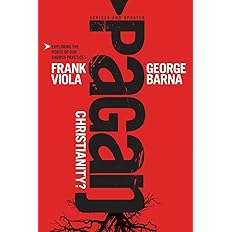
Allow me to start with Pagan Christianity?: Exploring the Roots of our Church Practices by Frank Viola (the baseball player?) and George Barna (the researcher), since it was published first (2012). The focal point of this book is that a lot of our church traditions are from pagan influences rather than the New Testament. The proposed reformation is to replace the institutional church with its senior pastor, sermons, and church buildings, with organic house churches. Here's the review I posted on Amazon:

"There are books that I think are on target, those that are dangerous, those that are neither (more educational or more entertaining), and those that are both. This fits in the last category.

"I've already come to some of the conclusions they came to. While I admire the big beautiful cathedrals, I wonder what would happen if the focus was on building the church through evangelism and missions instead of building bigger buildings. I also believe that there should be less distinction between clergy and laity.

"However, there are several things I disagree with. These include:

  1. A view that the NT prescribes a certain pattern of worship. Sorry, it's not in the NT.
  2. A view that appealing to the Old Testament is no better than a pagan view.
  3. An activist tone that isn't interested in any less than unconditional surrender.

"I did find myself scanning much of this book and reading the conclusions and the Q&A at the end of each chapter.

"They are right that most if not all features of the current institutional church are not from the Bible. The question is if it's from paganism (a bad influence) or if it's godly people desiring to serve Him."

The second book is Once You See: Seven Temptations of the Western Church by Jeff Christopherson, which came out in December, 2022. Like Pagan Christianity, this book looks at shortcomings of today's church and ways to reform - e.g. the pastors being bi-vocational. However, unlike the other book, this book is a novel. Here's my review of that book: 

"Once You See: Seven Temptations of the Western Church by Jeff Christopherson is a novel looking at three men who are in a crisis in their lives and in the church, and realize there is something more that's not being realized. But how does one reach that goal?

"This book would appeal to a Christian audience. Most Christian novels are stories first, and Christian thought is organic to the tale. My hunch is this book reflects concerns of the author and are told through story as opposed to a typical book. Christopherson has previously written missiological books, and is the executive director of both the Canadian National Baptist Convention and Church Planting Canada. This book comes with a discussion guide.

"I thought he constructed an interesting story. I am definitely interested in reading his other books, especially Venal Dogmata: A Parable of the Future Church."


Wednesday, February 2, 2022

ROMANS 14: THE GREATER CONTEXT - A STUDY ON ROMANS 14 PART 2 OF 11


Cool Creek Park, Westfield, Indiana

One bit of Bible study advice I've known since I started attending Bible College: "A text without a context is a pretext." So I will spend the next two sessions developing the context of Romans 14.

First, we need to look at where Romans fits into Scripture. Christians believe that there is a two part division of Scripture: The Old Covenant (or Old Testament) and the New Covenant (New Testament). The former focuses on Israel with a look at the coming Messiah and His Kingdom. The latter focuses on Jesus as the prophesied Messiah (Greek word for Messiah is Christ) and His present tense Kingdom in the Church (as well as looking for the future Kingdom when He returns). Romans - or more completely, the Letter of Paul to the Romans - is a New Testament book.

Allow me to take a step back here and point out that not all editions of Scripture, while having the same books, do not have them in the same order. The Jews have a different order of the books (and some of the books were combined - "The Book of the Twelve" is the same as the twelve Minor Prophets). Likewise, some of the New Testament texts would have a differing order of the four Gospels or may have the General Epistles preceding Paul's, but it is just a rearrangement of the same contents.

One interesting phenomenon is that Paul's letters are immune from this variation. Every edition starts with the letters to Churches, starting with Romans to the Thessalonian letters, and followed with the letters to Timothy, Titus, and Philemon. Les Feldick indicates that the fact it always has been in this order is God's design. On the other hand, Frank Viola proposes that the order is based on book length, starting with the longest (Romans).

Paul didn't plant the church in Rome, though some believe he did indirectly, being started by those discipled by Paul. In reading this letter, it is evident that his audience was mixed between Jews and Gentiles. Most believe Paul wrote this letter in Cornith, at the end of his third missionary journey on his way to Jerusalem, where he was arrested and eventually sent to Rome.

A common trait in Paul's letters was to start with doctrine and then move to practical application, and Romans is no exception. The first eleven chapters are doctrinal, and the remaining five are practical. (Keep in mind that the Biblical authors did not divide their writings into chapters and verses; these were done later for reference.)

Allow me to give a list of doctrinal foundations given that chapters 12-16 (including our focal point on chapter 14) are built on.

  1. No one is righteous (Rom. 1:18-3:18).
  2. Christ paid the penalty of our sins so we can be justified by Him through faith (Rom. 3:19-5:21).
  3. As Christ died for our sins and was raised, we should die to our past sinful life and live life in the Spirit (Rom. 6-8).
  4. God has cast off Israel due to their unbelief and grafted the church in through faith, but if and when they turn from their unbelief, they will be restored according to the Sovereignty of God. (Rom. 9-11).

 Are you all ready for a break after this? I am! So I'll be looking more at the context for the 14th chapter of Romans in my next installment.

But for those brave enough to answer a question I post in my blog (I haven't had many takers thus far), here's a question for you: With the four points I listed above, how would you say we should live? What does that look like?