Showing posts with label fellowship. Show all posts

Sunday, September 24, 2023

SUNDAY PSALMS PART 38 OF 48 - PSALM 122:1


Christians United Church, Indianapolis

I was glad when they said to me,
"Let us go into the house of the Lord."
Psalm 122:1, New King James Version

Aren't you glad when people say to you, "Let's go to the house of the Lord?" If so, why not?

Yes, unfortunately there are churches who love hurting people while others love hurting people. Wheat and tares are gathered together in the same sanctuary, and it's often there that the tares become recognized. When that happens, it's understandable why they don't want to darken the door of the church. 

However, does our experience take precedence over the words of the author of Hebrews: "And let us consider one another in order to stir up love and good works, not forsaking the assembly of yourselves together as is the manner of some, but exhort one another, and so much more as you see the day approaching." (Hebrews 10:24-25)? Because of the sin of others, are we granted permission of living in disobedience ourselves?

Is part of the problem that we're focusing on our own interests and ignoring the interests of others, contrary to Philippians 2:4? We're expecting others to love us, but are we loving each other? Maybe if we are treating each other as we should, they would be built up. Likewise, maybe we're called to stand up to those who are hurting others.

One thing to remember - the people we're either assembling with in church or avoiding by not assembling will be with us in heaven. Plus, they're all people Christ loves. And didn't Jesus say that if two or three are gathered together in His name, He's in the midst?

I don't know about you, but I'm glad when they say to me, "Let us go to the house of the Lord."


Sunday, September 3, 2023

SUNDAY PSALMS PART 35 OF 48 - PSALM 119:129-136

Cool Creek Park, Westfield, Indiana


129 Your testimonies are wonderful;
   Therefore my soul keeps them.
130 The entrance of Your words gives light;
   It gives understanding to the simple.
131 I opened my mouth and panted,
   For I longed for Your commandments.
132 Look upon me and be merciful to me,
   As Your custom is toward those who love Your name.
133 Direct my steps by Your word,
   And let no iniquity have dominion over me.
134 Redeem me from the oppression of man,
   That I may keep Your precepts.
135 Make Your face shine upon Your servant,
   And teach me Your statutes.
136 Rivers of water run down from my eyes,
   Because men do not keep Your law.
       Psalm 119:129-136, New King James Version

Once again, another good Psalm, and one I want to focus on one part: the last verse. Do rivers of water run down from your eyes because men don't keep God's Law?

Think about this. How much entertainment reflects men not keeping God's Law? How much has us cheering those who don't keep God's Law? How often are we laughing at disobedience? How often does it grieve us?

Let's look at where we get our information. Is it unbiased? Or does it reflect a heart that does not keep God's Law? Are they sympathetic to those of faith, or do they look at traditional values (aka keeping God's Law) as backward at best and a danger at worst?

What about our relationships? When there is disobedience to God's Word, are we grieved? Or do we shrug our shoulders? Do we tag along when they're going places we as God's Law-keepers have no business?

Do rivers of water run down from our eyes because people don't keep God's Law? Do we believe what Psalm 12:8 says: "The wicked prowl on every side When vileness is exalted among the sons of men."


Sunday, June 19, 2022

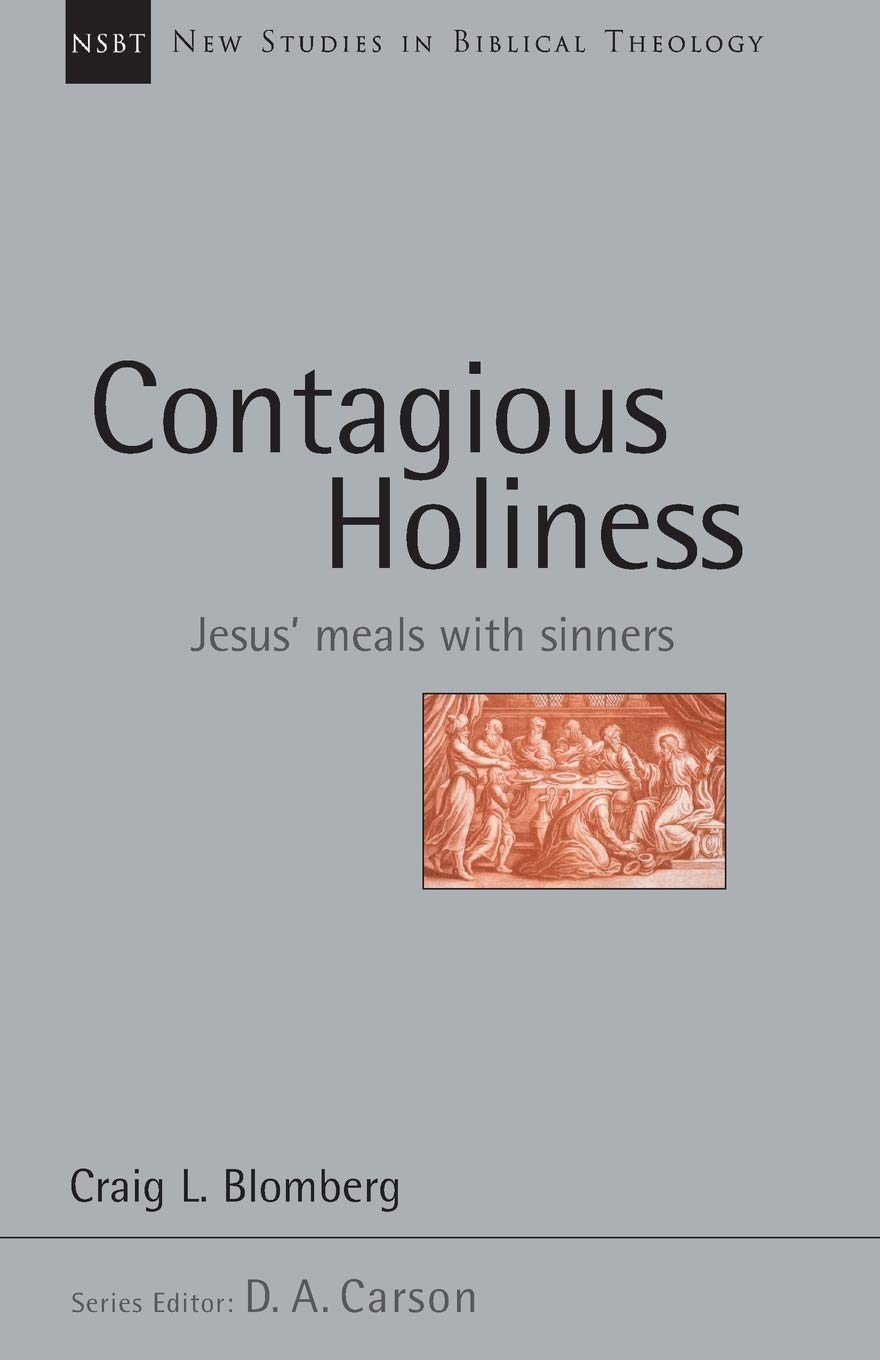
BOOK REVIEW - CONTAGIOUS HOLINESS: JESUS' MEALS WITH SINNERS BY CRAIG L. BLOMBERG


When Jesus ate with "tax-collectors and sinners," was it for the purpose of repentance? Did the meals fit a more traditional Jewish setting, or were they more patterned after the pagan Sypnosium of the Greco-Roman culture?

In "Contagious Holiness: Jesus' Meals with Sinners," author Craig Blomberg takes a look at meals during the Biblical era. First, he mentions two areas of debate:
1. Were the meals more after the Jewish tradition with the participants sitting at the table, or did it reflect influence by the Greeks and Romans, where those around at the table reclined with discussion, a lot of drinking, and usually some entertainment (often sexual)?
2. Were the "sinners" Jesus ate with the immoral, without Jesus offering any condemnation, or was it more those seen as impure by the Jewish Society with the goal of leading them to repentance?

Blomberg then launches into a study looking at meal customs through the Old Testament, extra-Biblical books including the Deutero-Canonical Books (also known as the Apocrypha) and the customs of the world, both Jewish and the conquering Greeks and Romans. He follows this up by analyzing Jesus meals in the Gospels, including the dinner with Matthew/Levi and his friends and his invitations by Pharisees, dividing it between the accounts exclusive to Luke and those that aren't.

This is the third book I've read from the New Studies in Biblical Theology series, and in each case, the conclusion and application segment is the best part of the book, as it gives practical ideas to live out what is learned. In this case, the encouragement is for Christians to invite people different from us (including unbelievers) for the purpose of getting to know them and be a witness to them. It gives several examples how this is done around the world, such as a Denver church called Scum of the Earth.

I do have a minor quibble. The author holds to the Priority of Mark (meaning Mark was the first Gospel written and along with an unfound quotation source called Q - no connection to Star Trek the Next Generation). In comparing the accounts of the Feeding of the 4,000 in Matthew and Mark, he commented that the order was different enough that he considers Matthew relying on oral tradition. Now wait a minute! Where was Matthew during this event? Wouldn't he have been there in the flesh with the other eleven and maybe other followers like Mathias? Couldn't Matthew's version be an eyewitness account? Okay, I'll get off my soapbox.

This book (and this series) is aimed at intellectuals, but it is easy to read and helps one understand the issue. I recommend this book (and again, the series).

Friday, April 8, 2022

WHAT'S SO GOOD ABOUT FRIDAY?

 If I had a dime for every time I hear someone say "Happy Friday," or "Wish it was Friday" or, of course, the cliche TGIF.

On the other hand, I often hear my wife Becky and the Hungarian Bible wish each other "Happy Sunday." Is that any different?

To be honest, I find the "Happy Friday" mentality depressing. Of course, the people who say that are at my place of work, and so I don't get to see them on the weekend. But it still saddens me. Why?

First off, it gives the impression that one day of the week - or at least one workday - is worth living, and the rest of the time, not so much.

Second, there's a reflection that work is a curse. We need to remember that Biblically, work preceded the fall and the curse. Adam had a job - he was a gardner. He had a job before he had a wife (probably the one who started that pattern). 

Let's approach it a different way. What dreams do youngsters have? They want to be a musician or an actor or an athlete. Guess what? To be good at any of these, it takes work! Maybe it seems more glamorous than the usual 9-5 or what used to be my pattern, the graveyard shift, though those who make a living at those things might think the shine is a little fainter than it was when they were young. 

I have a friend who had his foot amputated. He shakes his head at those who can work and don't; he's unable to work and wishes he can. 

To me, life is too short to not enjoy each day, even if it is mundane and boring. Do you like any of the people you work with? Is there satisfaction in doing a good job at your place of employment? 

Now, I would feel differently if that person who wished me a Happy Friday had told me "Happy Thursday" the day before and is also known to say "Happy Wednesday," "Happy Tuesday," and the inconceivable "Happy Monday." 

After all, I enjoy Mondays! It is a new beginning, a chance to improve on the job I did the previous week. 

Now, does "Happy Sunday" differ? For me, it does. It is not primarily thankfulness for what is not being done but for what the person is doing. Particularly, when stated among Christians when they're going to church, when they're meeting with fellow believers, when they're studying God's Word and singing praises to Him.


Friday, February 11, 2022

CHRISTIAN LIBERTY AS PART OF WHAT SHOULD BE A NORMAL CHRISTIAN LIFE - A STUDY ON ROMANS 14 PART 11 OF 11

Righteous Living Christian Church Indianapolis (Irvington)


Thank you very much to all of you who have followed this series. Hopefully it has given you things to think about. And PLEASE let me know your thoughts in a comment.

Allow me to debrief in this blog in three parts. 

  1. A return to context, particularly what follows Romans 14.
  2. How does Christian Liberty fit in with Christian life as a whole?
  3. What is the point of Romans 14 and Christian Liberty?

You ready? I am.

CONTEXT

Chapter 14 ends with a statement that what isn't of faith is sin. It goes right into Chapter 15 (remember there are no chapter and verse divisions in the original, and that they're added for reference), which states we ought to bear with the scruples of the weak and please others, not ourselves, according to Christ's example and be granted one mind with each other so as one we can praise and glorify God. Romans 15:7 repeats the theme of Romans 14:1, stating, "Receive one another as Christ as received you."

CHRISTIAN LIFE

Is Christian Liberty something that stands by itself? Let me give a list of important aspects of our everyday Christian life, and see if it fits.

Bible reading/study? Actually, it does. Each one reading Scripture comes with presuppositions, biases, opinions, traditions, knowledge (and lack thereof), and life experiences. Will they all be the same? Nope. Should they be? Only if God made us all identical. In other words, Nope. Thus, Christian Liberty is not only a part of group Bible studies but enables us to challenge our thoughts and grow as we listen to each other as equals.

Prayer? This one is tougher because prayer usually is between one and God, as well as agreeing with each other in prayer. If you want to say it doesn't fit here, I'll permit that. On the other hand, when we pray about struggles with other believers or learning to love them more, I believe there is a connection.

Fellowship? Does this question need to be asked? Clearly, Christian Liberty is a part of fellowship with fellow believers, especially when seen as a manifestation of loving one another.

Evangelism? I personally believe that Christian Liberty is designed for evangelism no less than for fellowship. Why? Because we have the freedom to go where God calls us. I know some friends who were in a Christian band. They arrived at the church they thought they were booked at and found an empty parking lot. They called their contact, and found out they were booked at a bar. Would your band play at a bar? Well, this one told the owner they sang Christian songs, shared between songs, and gave an altar call. The bar owner shrugged and said he needed a band. To make a long story short, a half dozen came to the band's church the next morning, got saved, and became active church members. This band exercised Christian Liberty by following Jesus into that bar. 

Righteousness/Holiness? A person acting in Christian liberty properly will be living righteously and holy; he/she won't be using it as a license to sin. However, do we agree what holiness/righteousness looks like? Uh, what about us all looking at things differently? Christian liberty discourages us from judging others when their view of holiness and ours differs.

WHAT IS THE POINT?

One weakness of the church (and human nature) is that we expect others to conform to our standards. Romans 14, as the rest of Scripture, teaches we should instead focus on others, letting them be themselves and be more concerned about us offending them than them offending us.

Okay. Series done. Your comments?


Sunday, September 26, 2021

BOOK REVIEW: CORPORATE WORSHIP BY MATT MERKER


This is the third of the 9Marks books I've read, and thus far it's my favorite. Matt Merker does an excellent job of pointing out why Christians should gather. (The Greek word translated "church" is εκκλησία (ekklesia), which means "an assembly.") He then points out how the church worship service is not just a show but where we can encourage each other.

One thing I like about this book is the author is aware his readers may disagree about other issues, and in his notes tries to present opposing views, keeping his focus on encouraging corporate worship.

Too often, in Christian circles "worship" is synonymous with "music." Merker (who is a musician/songwriter) does deal with the singing in the service, but he views the whole service to be worship and singing is just one form of worship during the service.

Allow me to add one area where I disagree with what he says, though I agree with why he says it, and he may agree with my ideas on the subject, which deals with Special Music. In fact, starting next Sunday (October 3, 2021), I'll be doing a four part series on church music.

I highly recommend this book for all Christians, and especially for pastors/elders and music leaders, not just to read themselves but have discussion groups with the congregation about this book.

What ways can you think of to develop Christian community, especially during the Sunday morning worship service?